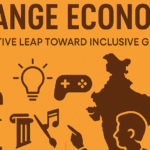
In an era where ideas are currency and creativity is capital, a new economic paradigm is reshaping global growth narratives—the “Orange Economy”. Once considered peripheral, creative industries today sit at the heart of economic transformation, employment generation, and national competitiveness.
From Concept to Global Discourse
The term “Orange Economy” was introduced in 2013 by Colombian economist Felipe Buitrago Restrepo and later championed globally by Iván Duque Márquez through their work with the Inter-American Development Bank. The choice of “orange” symbolised culture, creativity, and identity—elements long undervalued in traditional economic frameworks.
While the concept remained largely academic in its early years, it gained momentum between 2018 and 2022, as global institutions like the World Economic Forum began emphasising the economic potential of creative industries. The digital boom—accelerated by OTT platforms, gaming, and social media—further propelled it into mainstream discourse.
What is “Orange Economy”?
The Orange Economy encompasses industries where value is derived from creativity, intellectual property, and cultural expression. This includes sectors such as media, entertainment, design, fashion, advertising, gaming, animation, and digital content creation.
Unlike traditional industries dependent on physical resources, the Orange Economy thrives on human imagination and innovation, making it both scalable and inclusive.
India and Orange Economy
India stands at a unique intersection of opportunity. With the world’s youngest population and a rapidly expanding digital ecosystem, the country is well-positioned to emerge as a global creative powerhouse.
Recent policy and market developments reinforce this trajectory. The Government’s push for the AVGC-XR (Animation, Visual Effects, Gaming, Comics, and Extended Reality) sector signals intent to build global capabilities. Simultaneously, the explosion of the creator economy—millions of Indians producing content on platforms like YouTube and Instagram—has democratised access to creative careers.
The integration of creative learning within the National Education Policy 2020 further strengthens this foundation, recognising that future employability will depend as much on creativity as on technical knowledge.
Beyond Culture: An Economic Imperative
The significance of the Orange Economy extends far beyond cultural preservation. It represents a high-growth, job-intensive sector with relatively low barriers to entry.
For a country like India, this translates into:
- Mass employment opportunities, particularly for youth
- Strengthening of cultural exports and soft power
- Inclusive participation, from rural artisans to urban digital creators
- Innovation spillovers into traditional industries through design and storytelling
The Skills Economy Connection
The rise of the Orange Economy is inseparable from the evolution of the Skills Economy. Here, the premium is not on degrees but on demonstrable capabilities.
Creative industries demand a hybrid skill set:
- Creative thinking and storytelling
- Digital and technological proficiency
- Entrepreneurial and monetisation capabilities
This aligns closely with national initiatives such as the Skill India Mission, which aim to equip India’s workforce with market-relevant skills.
Skilling for a Creative Future
To fully unlock the potential of the Orange Economy, India must accelerate efforts in skilling, upskilling, and reskilling.
- Skilling must focus on foundational creative and digital competencies—design, video editing, animation, and content production.
- Upskilling should enable professionals to adopt advanced tools such as AI-driven design and immersive technologies.
- Reskilling will be critical as professionals transition from traditional roles into emerging creative domains.
For the Learning and Development ecosystem, this calls for a shift from curriculum-based education to portfolio-driven, practice-oriented learning models.
The Road Ahead
As technology continues to blur the boundaries between creativity and computation, the Orange Economy is set to converge with the digital and knowledge economies. Artificial intelligence, virtual reality, and global digital platforms will redefine how creative value is produced and consumed.
For India, the opportunity is clear—but so is the challenge. The country must move beyond recognising creativity as talent and start treating it as strategic economic infrastructure.
Conclusion
The Orange Economy signals a fundamental shift: from resource-driven growth to imagination-driven development.
In a nation powered by its youth, the question is no longer whether creativity can drive the economy—but whether the ecosystem can be built fast enough to harness it.
If India succeeds, the next wave of economic growth may well be painted not in industrial grey, but in vibrant shades of orange.