The Employability Equation™
Inspired by a Question. Built for the Future of Employability.
Conceptualised by and IPR of Dr Anand Wadadekar
For decades, society has measured a person’s readiness for employment through educational qualifications, marks, certifications and technical knowledge. Employers, educational institutions and even students themselves have often assumed that acquiring more qualifications automatically leads to better career opportunities. However, today the reality tells us a different story. Thousands of graduates possess impressive academic credentials but struggle to secure meaningful employment. At the same time, organizations frequently report that they cannot find candidates who are truly “job-ready.” This raises an important question and that is “what really creates employability?”
Employability is often discussed through isolated terms such as degrees, skills, experience, aptitude or attitude. Employers don’t hire on the basis of only one of these factors. They look for a combination of qualities that together determine whether an individual can contribute, adapt and grow.
Few equations in human kind are as iconic as Sir Albert Einstein’s E = mc². It represents the power of reducing a profound and complex concept into a simple, memorable equation that changed the way the world understands energy, matter and the universe.
While reflecting on the growing challenge of education, skills and employability as a whole in the 21st century, I found myself asking a different question. Could employability also be explained through a simple equation yet which has a deep value proposition but definitely not as a scientific equation or as a mathematical formula.
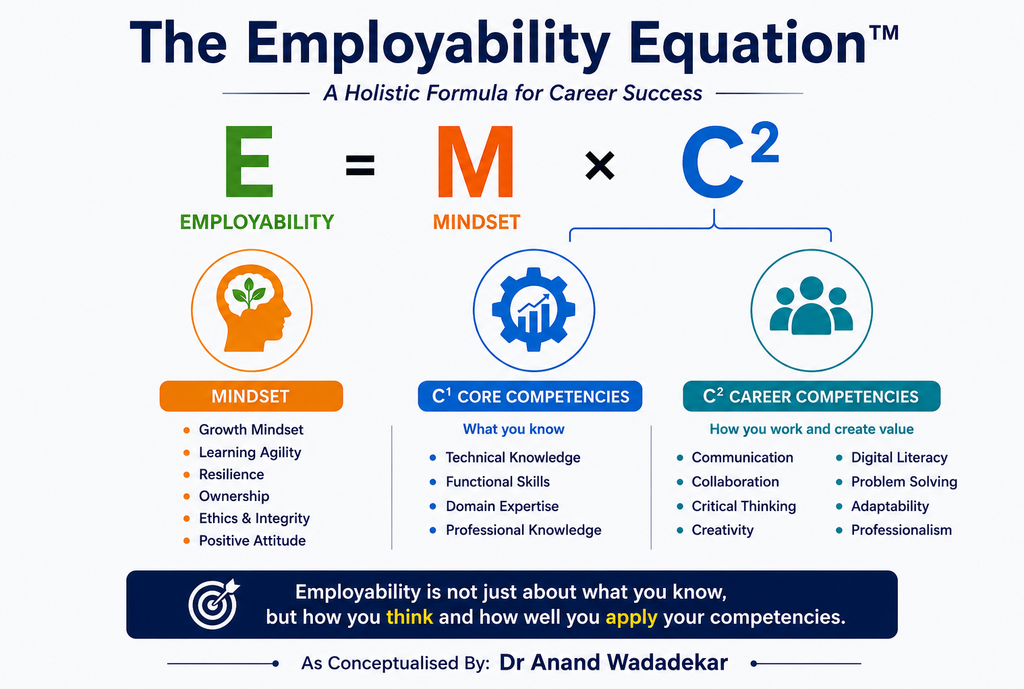
That question led me to conceptualise “The Employability Equation™: E = M × C². Where E is for Employability, M for Mindset, C¹ is for Core Competencies and C² is for Career Competencies.”
After reflecting on my two decades of working across education, talent development, learning, recruitment and student development, employability, today I conceptualised a simple framework and memorable framework.
The Employability Equation™: E = M × C²
Where, E = Employability; M = Mindset; C¹ = Core Competencies and C² = Career Competencies.
At first glance, it appears to be a simple equation, however behind this simplicity lies a comprehensive philosophy of career readiness. It is inspired by the idea that employability is never determined by a single factor. Rather, it emerges from the interaction of how we think, what we know and how effectively we apply what we know. Mindset, Core Competencies and Career Competencies together form the foundation of sustainable employability in the modern world.
Let’s understand the Equation:
E = Employability
Employability is much more than obtaining a job. It is the ability to secure opportunities, perform effectively, continuously learn, remain relevant, adapt to change, and grow throughout one’s career. In today’s rapidly changing world, employability is no longer a one-time achievement. It is a lifelong capability.
M = Mindset
Every career should begin with a mindset. Knowledge may open doors, but mindset determines how far a person goes after entering. Mindset represents the internal attitudes and beliefs that influence behaviour and performance. It includes growth mindset, learning agility, ownership, accountability, resilience, adaptability, curiosity, ethics, professional attitude, positive outlook.
Employers today increasingly are looking for candidates who are willing to learn, accept feedback, solve problems and embrace change. Skills can often be taught, mindset is considerably harder to develop.
C¹ = Core Competencies
Core competencies (1) include academic knowledge, domain expertise, technical knowledge, functional skills, professional knowledge, industry understanding, digital proficiency relevant to the profession. These competencies should be generally acquired through schools, colleges, universities, vocational education and professional training. However, technical competence alone is no longer sufficient.
C² = Career Competencies
Career competencies (2) include communication, collaboration, critical thinking, creativity, problem solving, professionalism, digital literacy, adaptability, emotional intelligence, time management, decision making, customer orientation, leadership potential.
These competencies determine how effectively individuals convert knowledge into workplace performance. Many organizations no longer reject candidates because they lack technical knowledge, but they reject candidates because they cannot communicate, collaborate, solve problems or adapt to changing business needs.
Both these competencies will increasingly differentiate exceptional professionals from average ones.
C² symbolises two equally important dimensions of competency: C¹ – Core Competencies i.e. what you know and C² – Career Competencies i.e. how effectively you create value using what you know. One without the other limits employability. True employability emerges only when both dimensions work together.
I have observed that a proper ‘mindset’ plays a big role in career success, since jobs, careers, roles, designations have become dynamic and are not linear. Therefore, Mindset Multiplied by C² tells us that mindset can amplify the value of competencies.
The Changing World of Employability
The workplace is undergoing unprecedented transformation. Artificial intelligence, automation, digital technologies and rapidly evolving business models are reshaping almost every profession. Technical knowledge alone has a shorter lifespan than ever before. In other way we call it as skills have a half-life (shorter shelf-life).
The professionals who will thrive are those who can learn continuously, unlearn outdated practices, adapt quickly, collaborate effectively, think critically, solve complex problems, work ethically, communicate confidently and therefore the Employability Equation™ recognises this new reality.
Implications for Students
Students should focus on more, apart grades. A strong academic record shall remain valuable, but it should be complemented by internships, projects, communication skills, teamwork, networking, leadership experiences, digital capabilities and continuous self-development. Your degree may help you get an interview but your mindset and career competencies can often determine whether you receive the offer.
Implications for Educational Institutions
Educational institutions have a significant opportunity to rethink employability. Beyond delivering academic content, they can intentionally cultivate growth mindset, workplace readiness, communication, critical thinking, problem solving, innovation, collaboration, professional ethics, lifelong learning habits.
Beyond Hiring
The Employability Equation™ extends beyond recruitment. It can be applied to career counselling, university employability initiatives, talent assessments, learning and development, leadership development, internal mobility, career coaching, workforce readiness programmes, employability research, skills benchmarking.
It provides a common language for educators, employers, students and policymakers.
Einstein’s equation transformed our understanding of the physical world. The Employability Equation™ is an attempt to simplify our understanding of the professional and career world. It is about using the elegance of a simple equation to explain a complex human and industry challenge.