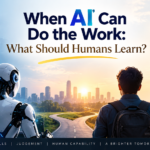
AI is rapidly moving from assisting humans to performing tasks that once required significant human effort. AI Literacy is now becoming a must-have workplace capability — but organisations are already moving toward AI Competency.
The difference is important: literacy is knowing and using AI; competency is applying AI effectively within a role and creating business value. At the same time, uniquely human capabilities are becoming more important, not less. Critical thinking, creativity, communication, judgement, collaboration and adaptability will increasingly define human contribution.
The question for educators and L&D professionals is no longer simply “How do we teach AI?” It is “How do we prepare people to work intelligently with AI while retaining human agency and judgement?” From Microsoft and PwC to Deloitte and the ILO, emerging workforce research points in this direction. And Bill Gates’ idea of “Human Reserved” raises an even deeper question: What should remain human even when AI can do it?
At NFLIG, we believe the future of learning lies in building AI Competency + Human Capability + Domain Expertise + Learning Agility.
Dr Anand Wadadekar – Founder President & CEO, www.NFLIG.com
FOOD FOR THOUGHT
Deloitte India: Campus hiring is becoming skills-first
Deloitte India’s Campus Workforce Trends 2026 reports that 86% of organisations surveyed say AI or Agentic AI is transforming recruitment processes. It also reports that 35% say AI adoption is creating new entry-level roles or skill requirements, up from 21% in FY25.
More significantly, employers ranked behavioural competencies (75%) and learning agility (72%) ahead of technical competencies as predictors of PPO conversion.
Deloitte: AI Literacy is evolving into AI capability
Deloitte’s AI-skills framework identifies five workforce segments:
AI-informed → AI users → AI integrators → AI builders/developers/architects → AI experts.
This is important because it demonstrates that “knowing AI” is not one homogeneous capability. Different roles require different depths and applications of AI competence.
ILO: AI literacy is becoming a foundational skill
The ILO’s August 2026 report Changing Landscape of Skills in the Age of AI states that AI adoption is increasing demand for cognitive, socioemotional, digital and AI skills.
It identifies AI literacy as an increasingly foundational skill, alongside adaptability, resilience and human agency.
IBM: Critical thinking and human judgement are becoming workforce priorities
IBM’s September 2026 CHRO study found that 71% of CHROs identified the ability to supervise, validate and override AI outputs as the workforce’s most essential skill.
The study also found critical thinking and human judgement among the capabilities CHROs consider important, while many employees expressed concern about skills erosion.
World Economic Forum: The AI divide is becoming a learning-to-earning divide
A September 2026 WEF discussion highlighted an important problem: young people may rapidly acquire AI skills, but knowing how to use AI does not automatically translate into employment or income.
Bill Gates: Should some work become “Human Reserved”?
In his August 2026 essay The Turbulent AI Era Is Here. The Choices We Make Now Are Critical, Bill Gates proposes a provocative idea: as AI and robots become more capable, society may deliberately designate certain activities as “Human Reserved.”
His argument is not that technology should simply be stopped. Rather, he asks whether there are areas where society may decide that the human contribution itself has value, even when a machine could technically perform the task.
PwC: The AI divide may become a learning divide
PwC’s 2026 Global Workforce Hopes and Fears Survey, published September 29, reports that almost two-thirds of workers now use AI, while access to learning and development resources has declined. It identifies 56% of workers as the “engine room”, with comparatively limited access to AI, learning and opportunity.
Is It Time to Rethink Aptitude Tests for MBA Hiring? – Article
The Employability Equation™ – Inspired by a Question. Built for the Future of Employability.
Where, E = Employability; M = Mindset; C¹ = Core Competencies and C² = Career Competencies.

Initiatives of National Forum for Learning, Innovation and Growth (NFLIG)
HER Career Compass – ONE-TO-ONE ONLINE CAREER COUNSELLING & MENTORING FOR WOMEN BY WOMEN
National Trainer & Coach Network (NTCN) – Aiming to be India’s largest and most vibrant professional networks for trainers, coaches, learning & skilling professionals.
Career Clinic (Online) – Expert Career Guidance. Informed Decisions. Confident Futures – For Whom? – Students, Graduates, Parents, Young Professionals, Working Professionals
Academy and Consulting – Learning Academy, Consulting Corporate — People & Organisation, Consulting Corporate — Future Skills & Leadership, Executive Coaching, Consulting Education
The Great Skill Shift – A 25-Year Chronicle of India’s Journey from Credentials to Capability (2000–2025)